Steelhead Closures: Now What?
Despite a historic and devastating wildfire season and yet another round of steelhead closures, all of us at Royal Treatment are trying to keep a positive vibe going in the shop to encourage everybody to keep getting out and finding ways to enjoy ourselves on the water with a fly rod in hand.
With the recent steelhead closures, my fall fishing plans suddenly became wide open. For me and many others, once August rolls around, we become singularly focused on steelhead. No other fish exists in my mind's eye.
Since becoming an Oregon resident, I have always made well-intentioned declarations that I will be taking time away from my normal late summer and fall steelhead fishing to explore the other rivers and migratory fish runs Oregon has to offer during a typical summer steelhead season. I will admit this here and now. Almost four years later, I have rarely ventured beyond my east-side steelhead rivers from August until the quick transition to winter steelhead fishing in January. For me, this has left a lot of what our area has to offer unexplored.
The feelings of frustration and loss are still burning bright with the imminent Deschutes (and most likely all other eastern Columbia River tribs) closure that begins this Saturday, August 15. But those feelings have lost some of their intensity as I look forward to the next few months and all the other incredible fishing opportunities that I have neglected in past years thanks to my crippling steelhead fixation.
Whether you’re a die-hard steelheader trying to make the most out of the rest of the season, a beginning angler, new to the area, or just curious about something new and exciting to chase with a fly rod, I will be putting together a few posts over the next few weeks about alternative locations and tactics within a few hours' drive in all directions from the Portland-Metro area. These are fisheries that I have always wanted to experience but have found myself distracted by steelhead.
The Coast
Sea-Run Cutthroat
If there ever was a fish with the regality similar to steelhead, it would be their little cousins, the sea-run cutthroat. Each time I’ve held one ready for release, I've been shocked at their subtle hues of gold and pink that shine in the early morning light between infinite spots.
This year, I’m excited to dig out my light two-handed and single-handed rods paired with integrated Scandi lines like the Scientific Anglers Spey Lite Integrated Scandi, ready to swing small wet flies and skaters. Being on the coast during fall, when the vine and broad-leafed maples are changing colors, is a religious experience itself. Throw in swinging flies to hard-fighting, acrobatic, ruby-throated, chromatic cutthroats, and this can be a great way to spend a later-summer or early-fall day.
These fish present a low-pressure fishing alternative to the dawn-to-dusk steelhead regimen. Sure, you can approach fishing for sea-runs with the same tenacity it takes for steelhead, but with the highly aggressive nature of cutthroats, timing throughout the day can be less of a factor.
In estuary and tidewater locations, it’s a great idea to arm yourself with a box full of small baitfish patterns such as Clousers and Mini-Ceivers, to be cast and retrieved to target fish feeding during the tides. This time of year, be ready to encounter early pods of coho or, in certain areas, fall Chinook!
Salmon
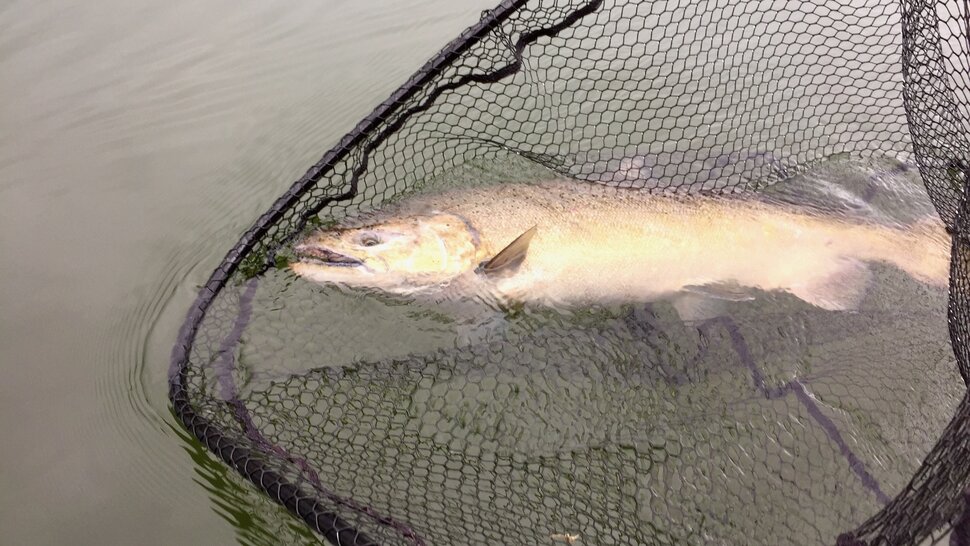
Coastal salmon fishing in tidewater will soon begin to heat up. We begin to see pods of coho and fall Chinook enter rivers in fishable numbers in early fall, but there is always the potential to connect with feeding fish in tidewater before they begin their upstream migration.
Oregon’s North Coast rivers typically have long tidal estuaries, which makes salmon fishing somewhat challenging without a boat. The best way to fish is out of jet boats or anchoring drift boats near clear travel lanes, casting and retrieving baitfish patterns with 8- to 10-weight rods. Intermediate or type 3 shooting head lines like Rio’s Outbound Short are the perfect option to cast long distances without tearing a rotator cuff. Sinking lines will help get your fly down to the fish quickly and allow you to cover water efficiently as you try to intercept traveling fish.
Locations, tactics, and timing vary widely between different coastal systems, so give us a call or swing by the shop to hear the latest reports we get from our North Coast rivers.
We are all disappointed to miss out on our Deschutes steelhead season. But next week, we’ll go over other great options for those of us not ready to pack away the two-handers and Wheatleys. Cooler temps are not far away, and with that comes numerous options close to home.
Leave a comment
Recent articles
View all
Going Rogue
Still Swinging