

Is The King Dead?
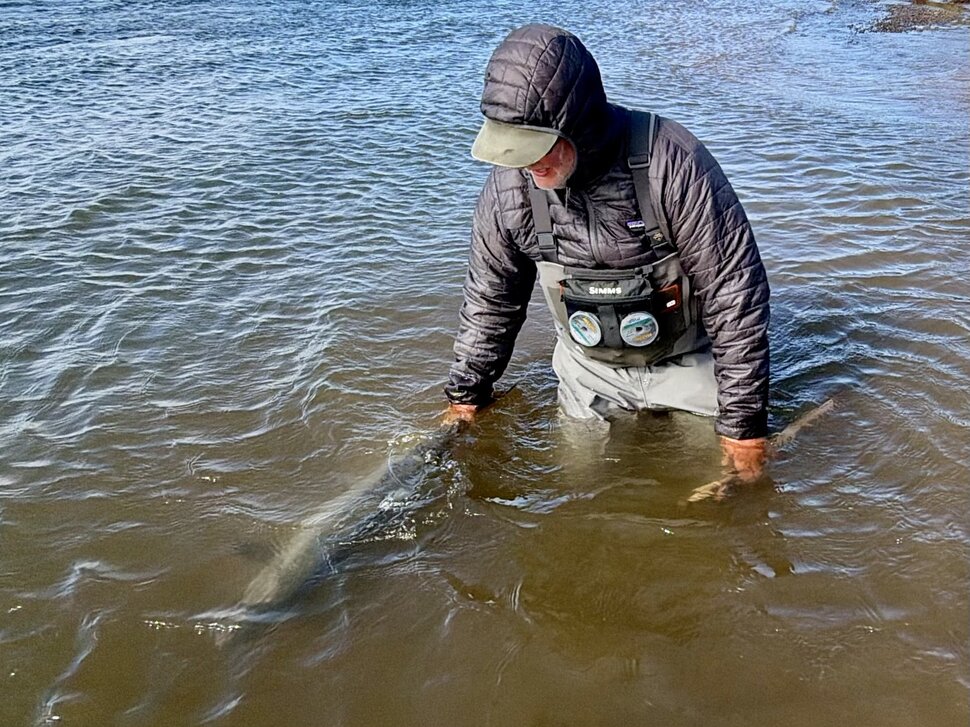
This year, as in years past, I took my annual pilgrimage to Alaska to chase kings. I was fortunate this year, as I was going to be there for two weeks fishing with a bunch of good friends.
I have caught quite a few Kings and guided people into even more. My first trip to AK was in 2000, and I started guiding up there in 2004. In the past 5 years, I’ve easily landed 100, my fair share and yours, and I still love the thrill of it. It’s not for the faint of heart: lots of bugs and itchy mosquito bites, tough casting with big flies, and heavy sink tips, but that pull makes it all worth it.
I left Oregon Thursday morning and got to the airport earlier than usual. We pulled up to the Alaska terminal and the place was empty. I tried to check my bags the night before, but it wouldn’t let me, so I tried at the kiosk. Again, the place was empty, which I immediately thought was a bad omen. Again, I wasn’t able to check my bags, so I needed a customer service agent. About an hour later, we had it all sorted out.
Well, to make a long story short, my flight to Anchorage, which was supposed to get me there in the early afternoon, didn’t happen. The plane broke down, I missed my connection, and to top it off, the airlines lost my bag with my waders and all my clothes. I knew the empty airport was a bad omen….
Finally I met up with Geo and the Mayor around 8 pm. We got some drinks, and I finally ate some food. Alaska Airlines found my bags, and they delivered them around midnight. Things were starting to look up.
We headed to the airport early Friday morning for our flight to King Salmon, then out to our camp on the Nushagak. We were all getting excited. When we got close to our camp, we asked the pilot to fly up one channel and down the other so we could see what it looked like. Over the past couple of weeks, I had been getting reports about the big ice flood and how much of the river had changed. From the air, it was hard to tell, but there was certainly evidence of destruction: uprooted trees, buildings knocked off their foundations, and tall, cut banks that had collapsed.
We landed and were met by our good friend and camp host Nigel. Nigel is quite a character; he’s British, 75, started guiding in ‘73, and is still going hard.
After unloading the plane and settling in, we set to work on rigging rods and getting ready for the evening fishing. Fortunately, being this far north, it doesn’t get dark till around 2:00 am. So we had quite a few hours of fishing in front of us.
Since there were four anglers- George, Keith, Jeff, and me we would be splitting up into two different boats. We’d be able to cover more water and search for the fish a little easier. Since we had been there a few times before, we already had a plan of attack. One boat would fish the runs in the east channel where the camp was situated, and the other would head up the west channel. Both channels had three really good runs to fish. Jeff and I stayed in the east channel where the camp was situated. While Geo took Keith up the west side so he could see all the different pieces of water to fish.
The river was surprisingly low. Everyone was telling us it was late-summer low flows, and it looked like it.
When we were on the ground, you could immediately see the damage caused by the ice flood. As my understanding has it, the river was frozen over as usual, with large snowdrifts and a lot of ice. As it started to thaw and break up quickly, the river rose, and water got between the ice and the ground, so the big chunks started sliding downriver, tearing up the bank. Then, in a few different spots, ice dams built up, causing high water and the chunks of ice to back up, causing even more damage. Up Camp was fortunate because it is on an inside bend and elevated about 15 feet off the water. The other side of the river has a low spot, so the water could spread out and flood over the banks.
Jeff and I headed up and across to our favorite spot. This run usually pumps out fish, especially when they are on the move. We parked in our normal spot and immediately noticed how different it was. Where we normally park, it was about 4 feet deep. We worked our way up the bank, walking the edge, and could see how much it had changed. The whole bank had been carved out. This run is an outside bend, so the ice had been grinding away at it.
Jeff stopped in the upper middle of the run, and I went for the top. It was so deep I could barely step off the bank, and I couldn’t even get to the top starting spot. I started working out my shooting head and running line. I was tight to the trees, and the casting was difficult. On my third cast, I felt that jolt of energy; the line came right, and I was hooked into a fish. After a minute or so, the fish fell off. I must not have had a good hook set, or it was in the hard part of its mouth and didn’t penetrate. That first fish came to a new color combo I had tied, a chartreuse popsicle. Purple head, red middle, and a chartreuse butt.
We fished the bank slowly with caution as it was a difficult deep wade. As usual, I was wading near the top of my waders when I took one step too deep and went over the top. We finished the run and decided to go explore a spot downriver we had been calling Bear Point. The only spot where we had seen a bear over the years we’ve been fishing there. Typically it’s a harder wade on another outside bend.
We stepped in, Jeff started below the boat, and I started above. This spot had filled in and was easy wading. A short way down the run, Jeff hooked into his first fish. After a good battle, he slid the fish onto the beach. We snapped a quick picture and set it free. So far, we've felt like this was a good start to the trip.
Later that evening we met the other guys for stories and cocktails. They had also hooked a fish. Little did we know that the drought was about to begin.
The next day we were up early, excited, and ready to do some damage. I think we scratched out one fish, and that’s the way it was for the next couple of days. One fish here and there. We were getting daily fish counts, and by the end of the week, the return was shaping up to be the worst on record. When those guys left, and my group of guys showed up, the high rod had landed three kings. It wasn’t looking good.
The boys rigged up their rods, and we split up into two boats again. I gave everyone a tour and showed them all the runs we have been fishing. We all headed downriver to a run we had been calling "porcupine." This run was downriver a couple of miles, a long wadeable bank on a slight outside. We could all easily spread out, and we started making laps. A guide boat hooked a fish out in front of us, and we felt a little excitement, invigorating us all and giving us hope. On the next lap, Eric hooked a real king, pushing 20lbs. After a good battle, Eric beached it, and we snapped a few photos. We made a few more passes and hooked a couple fish, both kings and chums.
As the week progressed, the fishing got better and better. By the end of the week, we had landed three fish around 20 lbs, and all of us had quite a few fish to hand. I spent a lot of time sitting in the boat, watching, basically guiding, releasing fish, and snapping pictures. It reminded me of my days guiding kings on the Sandy. I love being able to share these experiences with friends, seeing them succeed and their excitement. I don't know if I can do two weeks again, but I’d like to try. Hopefully the king isn’t dead!
Leave a comment
Recent articles
View all
Going Rogue
Still Swinging
Comments