
Twitchy Twitchy
Early on in one’s angling career, we are taught the importance of a “drag-free” drift when chasing Trout. Insects don’t surf, and any unnatural movement of the fly will send wary Trout scurrying for cover. We practice reading the currents and mending the line to make our offering look as natural as possible as it drifts lifelike downstream. Then we go to the Collon Cura and Limay rivers in Argentina, and all that goes out the window.
It’s a hard ask to cast a dry fly without mending the line, but our guide, Tomas, had to gently remind me a few times before I settled into the rhythm of presenting a large “Water Walker” to the resident Trout population. Casting straight towards the bank and allowing the belly of the line to drag the fly towards the center of the river at a high rate of speed seems counterproductive at best, but I soon learned it was just the opposite, as a chunky Rainbow crushed it before it reached the hang down. Later, as the current slowed, the speed of the skating fly bogged down, but Tomas was ready with his “twitch it’ command. “Twitchy Twitchy” was something we learned from our guide Nicolas the previous year, and it became the battle cry as we floated over fishy-looking water.
The Twitchy Twitchy is something seldom used by most Trout anglers back home, but I’m beginning to see a place for it in my “bag of tricks.” I soon developed a random timing for the Twitch that made the fly dance as it skated over deep pools, amazingly drawing fish up from the depths.
Then, when the tail-out approached, Tomas had me change to a quarter downstream cast, with a mend, allowing the fly to dead-drift, but then adding a Twitchy Twitchy to elicit a reaction from lurking Trout. I found out that a twitch was often followed by a splashy eat, so it was best to pay attention.
While Tomas’ strategy seemed random at first, I soon began to recognize the type of water for each technique, and only received input when I got lost in the beauty of my surroundings, and the gratitude for being able to return to these magical rivers.
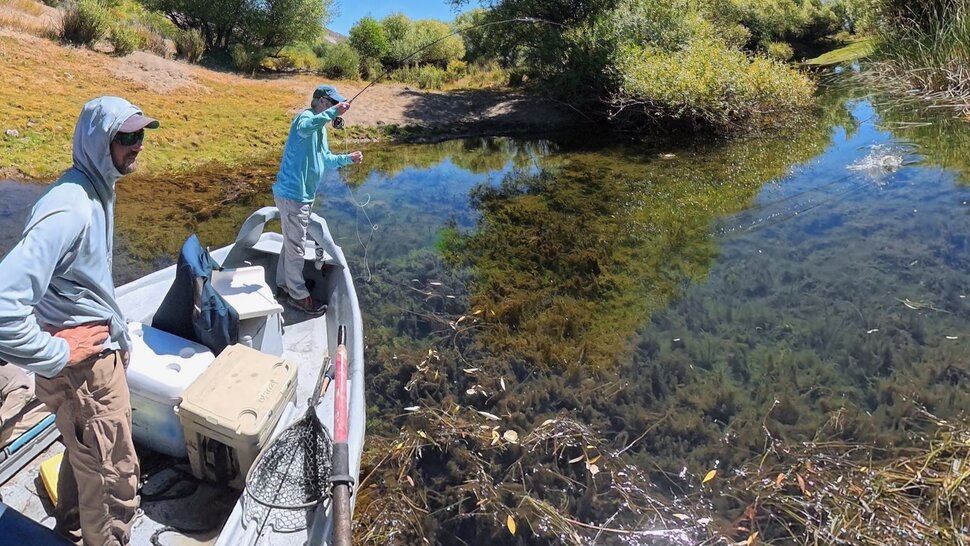
One afternoon on the Collon Cura, we were seeking the perfect lunch spot out of the wind when Tomas decided to “explore” a back channel that flowed into the main river, crystal clear. While the river was very fishable, it was not as clear as last year due to recent rain, which caused a clay bank to collapse a week before our arrival. This spring-fed channel was more like a pond, with reeds and overhanging trees shading the water, which was four to six feet deep. A heavy moss grew up from the bottom, making it look more like home for Bass than Trout. My suspicions proved true as two large Purca (native Perch) finned away as we pushed deeper into the pool, but then we spotted the Trout.
Lying in about three feet of water, the sizeable Trout was suspended in a clearing in the moss, seemingly floating in the air. Tomas had suggested a fairly large size 8 Black Beetle, which was now tied to my 2x tippet, far too heavy for this application. Experience told me this was a long shot, but I made the cast, landing the fly a short distance in front of the fish. “Twitch it.” I complied, and the beetle sent ripples out like a struggling terrestrial. Slowly, but without hesitation, the Trout moved to the struggling prey and took it in. A close-combat struggle ensued as the fish ran for cover under moss and weeds, until it was finally brought to the net and released, the 2x tippet proving a valuable asset. Further up the channel, we repeated the same event before pulling ashore for lunch. As we dined in the shade, Tomas commented that those Trout had probably never seen a fly, explaining their lack of caution. Nevertheless, adding a Twitchy Twitchy to the presentation had sealed the deal.
After lunch, on the way out of the channel, a blind cast with my trusty Water Walker and an added twitch brought an aggressive eat from a lurking Brown Trout. By now, I was fully committed to the Twitch.
Moving on to the Limay River, fully versed in the Twitchy Twitchy, we had to adjust to much bigger water with pools over 20 feet deep. Still, skated and twitched flies brought aggressive top-water eats from Browns, Rainbows, and Lake Run Browns, which exploded on surface flies. Providing entertainment and excitement for everyone on the boat as we watched our flies work through the likely water. In a couple of cases, monsters emerged from the deep, pushing waves of water, only to disappear back into the depths unseen. The Limay holds some truly scary-sized fish, especially when you’re holding a 9’ 6 wt. fly rod.
Still, not all “eats” were explosive. In one riffle, my fly was twitching through a seam, and a small nose pulled it under. I set the hook softly to not pull the tiny Trout out of the water, but then the rod bent over under the pull of a heavy fish. Slightly embarrassed, I brought the fish to hand, a beautiful Rainbow that would pass for a Steelhead on any river in the West.
Now, to apply what I've practiced on fish in some of my favorite waters. Salmon Hatch on the Deschutes is an obvious choice, but I'm thinking ahead to our Fall Road Trip and a few rivers I know with lurking monsters.
Leave a comment
Recent articles
View all
Family time

Dealer Days and Back Again